Lesson 1 - Jazz Chords
Using this app
This jazz guitar method will help you discover and understand how jazz chords are built, and how to use them in different styles. It’s best to already have some guitar basics to get the most out of it. Reading is presented here as tablature, but you can choose how it’s displayed in the “Tools” section. A printable PDF version is also available from the home screen.
The lessons introduce ideas that will come up again throughout the app, so it’s important to work
in chronological order.
You also have access to multimedia content: video, audio, and chord/tablature pages
(the landscape view is meant for efficient scrolling).
From the scale to chords
The C major scale is made up of the notes: C – D – E – F – G – A – B.
Note: some notes (the accidentals shown in gray) are not part of the major scale. You’ll find them in other scales and harmonic contexts.
Starting from each of these notes, you can build three‑note chords (triads) made of the root (the note that gives the chord its name), a third (major or minor), and a fifth.
Reading the chord diagrams
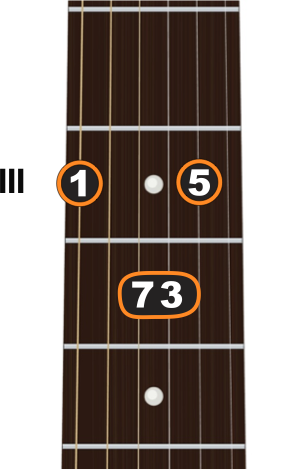
In the diagrams used in this app, the numbers refer to chord tones (not finger numbers).
 Root
Root
 Third (major or minor)
 Fifth (flat or raised)
 Seventh (minor or major)
(root),
E (major third)
and G (fifth).
Next, add a fourth note to get a seventh chord. This note enriches the chord and gives it color.
For example, adding B♭ to a C chord gives C7, a very common sound in blues and jazz.
Notice that B♭ (or A#) is not in the C major scale.
On the other hand, adding B (a half‑step below C) stays within the major scale and gives
C major seventh (written Cmaj7 or C7M). In that case the seventh
( ) is major.
This is our first jazz chord.
Example 1: Cmaj7 or C7M
This first chord in the harmonized scale contains:
- C (tonic / root)
- E (major third – 4 semitones above C)
- G (perfect fifth – 7 semitones above C)
- B (major seventh – 1 semitone below C)
D
E
F
G
A
B
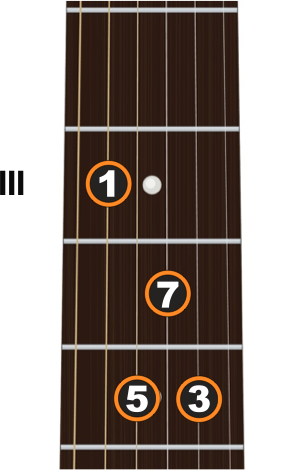
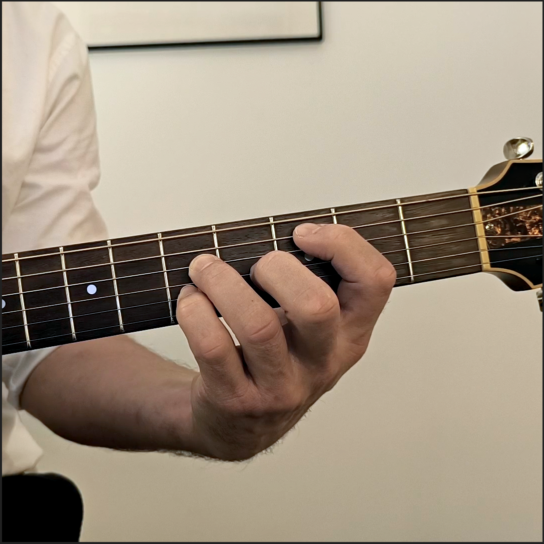
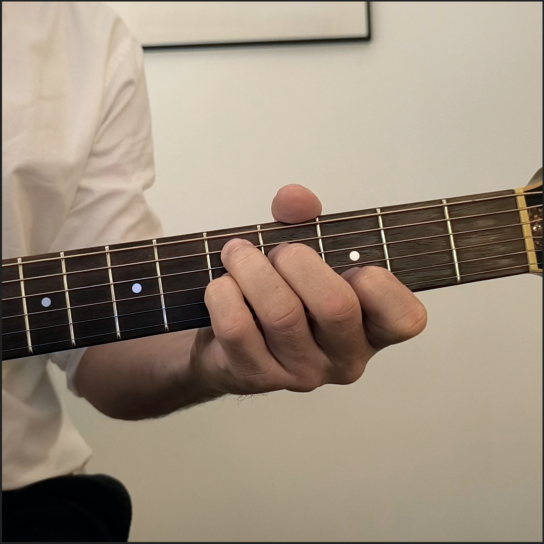
You can play this chord as a barre on the 3rd fret, but you’ll quickly notice that switching to other chords is much easier with this non‑barre voicing.
Example 2: Dm7
Starting from D, we build a minor chord that contains:
- D (root)
- F (minor third – 3 semitones above D)
- A (fifth)
- C (minor seventh)
E
F
G
A
B
C
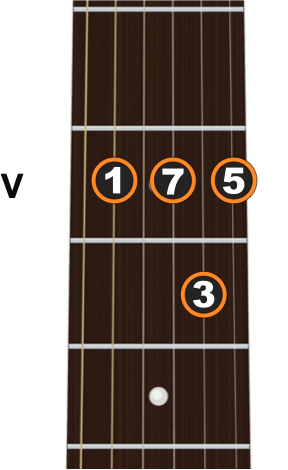
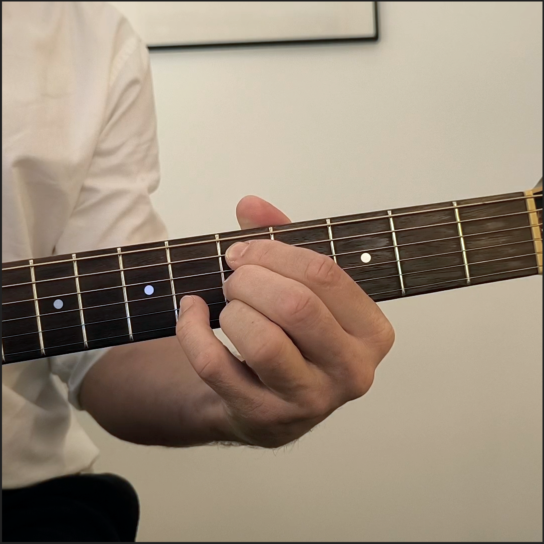
As with C7M, use a non‑barre fingering.
Chords and scale degrees
From the C major scale, we can now build four‑note chords called seventh chords (tetrads).
The chord name comes from its root, and we then stack notes from the major scale (third, fifth, seventh).
That’s why some degrees produce major chords and others minor chords.
We get the seven diatonic seventh chords of the harmonized scale:
Jazz progressions very often use the II–V–I cadence.
It’s a very satisfying sound, based on motion by fourths (or descending fifths).
The 5th‑degree chord (V) is unstable, and our ear expects a return to the I: that’s called resolution.
Progression in C
Choose the three chords highlighted above. G7 has exactly the same shape as Dm7, shifted over by one string.
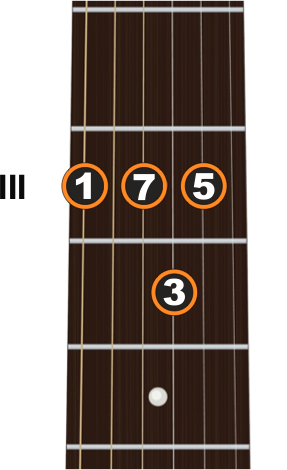
- Play this progression fingerstyle, plucking only the circled strings. Play Dm7 once, G7 once, and C7M twice.
Progression in G
Building chords from a G major scale gives the following harmonized scale:
Again, spot the characteristic II–V–I chords:
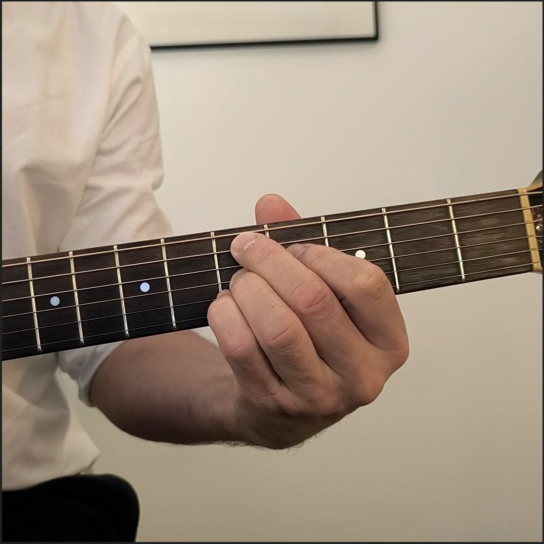
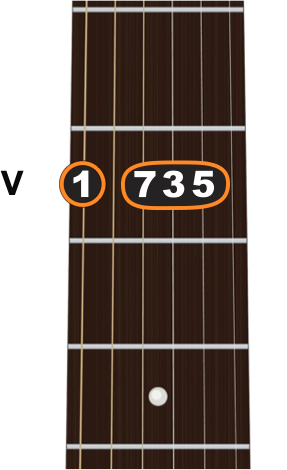
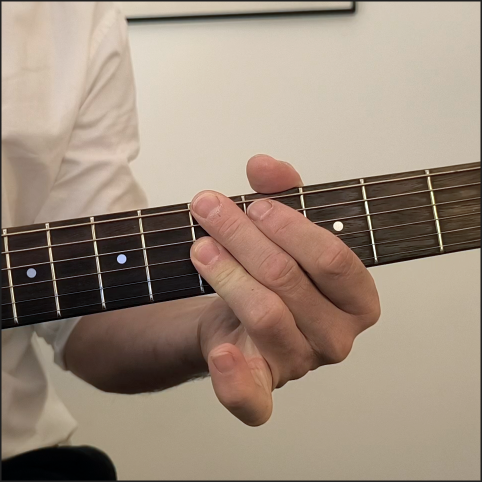
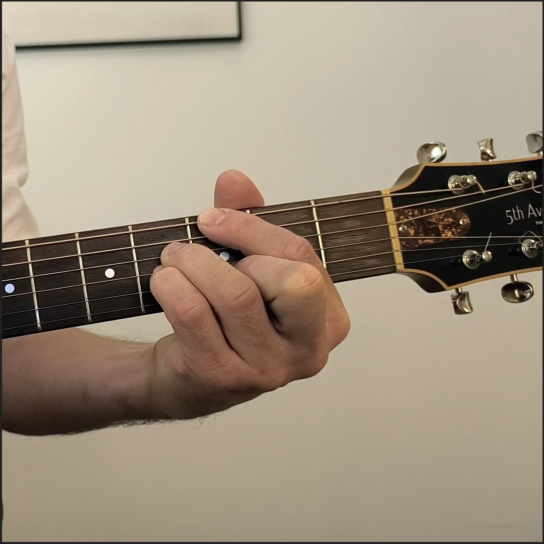
- Am7: play the root with your middle finger, and use a mini‑barre with your ring finger for the other three notes.
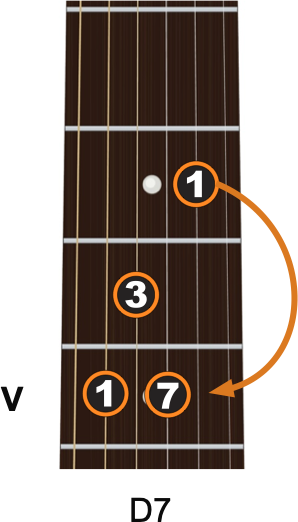
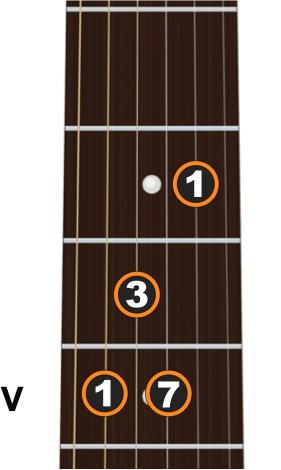
- D7 is a C7 shape moved down two frets (toward the nut).
- G7M is played without a barre, one finger per string.
- As before, play Am7 once and D7 once, then G7M twice.
A tune in two parts
1. Progression in C
The chords are played plucked (fingerstyle): each note should ring clearly. The tune continues with a “walking bass”. Here, the chord root is approached by a note (played with the thumb) a half‑step above or below. The rest of the chord is played with the fingers, as if you were covering two instruments.
2. Progression in G
We find our II–V–I again as plucked chords. Then there are two “walking bass” feels:
- The first one in straight (binary) rhythm
- The second one with a triplet (swing) feel
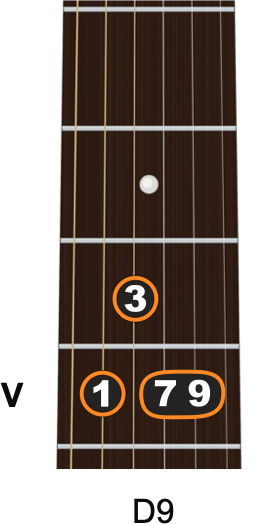
By adding a ninth (9th) to D7, you color the chord and get D9.
This voicing makes it easier to move through the progression.